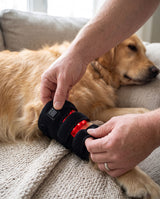
Red light, in plain words

The science of it

Red light, in plain words

Photobiomodulation is the research name for shining low-level red and near-infrared light on the body. What it is, what the studies in dogs found, and what we will and will not claim.

  1. 01

    What it is

    Low-level red and near-infrared light. Not a heat lamp, not UV, not a cutting laser.

  2. 02

    What the light does

    Cells in the skin and the tissue below absorb some of it. Studies look at how that changes comfort, stiffness and how joints move.

  3. 03

    Why the dose matters

    Studies give light on a schedule for weeks. Petciety is made for gentle daily sessions at home.

Two kinds of light

Red stays near the surface, near-infrared goes deeper

Red light (660 nm) is visible and is mostly absorbed in the skin and the tissue just under it. Near-infrared sits just past what eyes can see and travels further, toward muscle and the tissue around joints. Using both in one session covers more ground.

  1. Red light, 660 nm: the surface

    Absorbed in the skin and the tissue just beneath it.

  2. Near-infrared, 850 nm: deeper

    Travels further, toward muscle and the tissue around joints.

  3. Which Petciety pieces use which

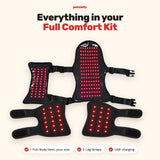
    The Cat Vest lists 660 nm red + 850 nm near-infrared. The vest and the Hip + Leg Sleeve use red + near-infrared; the Leg Wrap and the Mat use red light with gentle warmth.

Red light reaches the skin, near-infrared light reaches deeper toward muscle

Delivery matters

Fur is why the light has to touch the body

Fur scatters light, and light fades fast with distance. A lamp or wand held above the coat spends much of its glow on the fur before it reaches skin.

  • LEDs rest right on the body, no gap
  • Covers the whole area at once
  • Hands-free for the full session
Handheld devices
Handheld devicesSpreads on fur

Held above the coat, the light scatters

Petciety
PetcietyRight on the body

LEDs rest on the skin, the light goes in

The studies, one by one

What researchers did, what they found, and the limits

Four papers that shaped how we think about red light for pets, including one that found no benefit.

Randomized, blinded, sham-controlled | 2018Positive

Stiff elbows in 20 dogs

What they did
20 dogs with elbow arthritis were split at random. 11 had light therapy from a clinic laser on both elbows and 9 had a sham session with no light, for 6 weeks. The people scoring the dogs did not know which group was which.
What they found
The light group improved more on lameness scores than the sham group, and owners rated them more comfortable on most of the comfort questions.
The limits
A small study. A clinic laser at a set dose, given by staff, not an LED wrap at home. It tells us about elbows, not every joint.

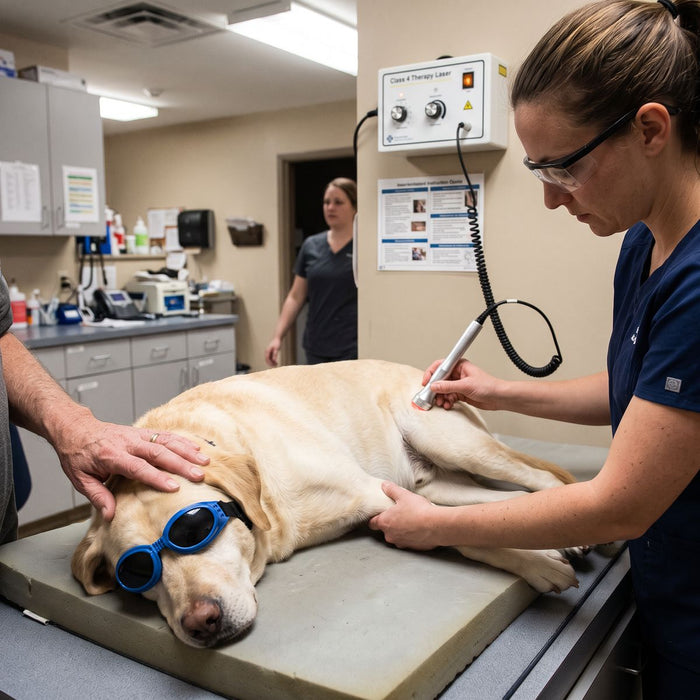
Looney AL et al. Can Vet J. 2018;59(9):959-966

Randomized, double-blinded | 2022Positive

Stiff hips in 20 dogs (40 hips)

What they did
20 dogs with arthritis in both hips. One group had a Class IV clinic laser over 3 weeks, the other a 21-day course of a common anti-inflammatory medicine. Dogs were checked at day 8, 15, 30, 60 and 90.
What they found
The light group scored better on pain and function at several checkpoints, and joint range of motion improved from day 15 through day 90.
The limits
No sham group, so it compares light with a medicine, not with nothing. Small, and a high-power clinic laser.

Alves JC et al. Am J Vet Res. 2022;83(8)

Randomized, controlled | 2018No benefit found

Recovery after knee surgery in 12 dogs

What they did
12 dogs had knee surgery (TPLO) for a torn ligament. 6 had low-level laser sessions for 8 weeks after surgery, 6 had plain red light as the comparison.
What they found
The laser group did no better. On some measures the red light comparison group did a little better in the first weeks.
The limits
Very small, a surgery recovery setting and a low laser dose. It is one reason we never promise results after surgery.

Kennedy KC et al. Am J Vet Res. 2018;79(8):893-904

Systematic review | 2023Mixed

45 studies of light therapy in animals

What they did
Researchers searched three databases for animal light therapy studies from 1980 to 2020 and rated each one for bias. 24 were in dogs, 1 in cats, the rest in horses.
What they found
Some studies reported benefits, but results conflicted, partly because each study used a different wavelength, dose and schedule.
The limits
Most studies had a moderate or high risk of bias. The authors call for larger, better trials, and so do we.

Millis DL, Bergh A. Animals. 2023;13(4):667

Every study here used clinic lasers or clinic devices, not Petciety. We share them so you can see where the idea comes from and how strong the evidence is.

Honest by design

What Petciety does, and does not, claim

Red light is promising, not magic. Exactly where we draw the line.

What we say

  • Red and near-infrared light is studied in dogs, mostly for stiff joints
  • Petciety is made for gentle, hands-free comfort sessions at home
  • Most pets find the warmth relaxing, and many fall asleep
  • You get 60 days to see how your own pet does

What we never say

  • That it cures, treats or heals any condition
  • That it is FDA cleared or a medical device
  • That it replaces your vet, medicine or surgery
  • That the studies above tested Petciety (they used clinic lasers)
  • That every pet will respond the same way

Pet with a diagnosis? Use Petciety alongside the plan you already have, not instead of it.

Real pet owners, real words

“This morning he greeted me on all four legs”

Real comments pet owners left about red light at home, copied word for word.

Raw, unedited comments

Senior dog owner

This morning he greeted me on all four legs, wagging his tail.

Dog owner

Relaxation within 5 mins of putting it on.

Senior dog owner

It helped him a lot, especially getting up in the morning.

Senior dog owner

She has been running like a puppy.

Dog owner

more comfortable jumping up on to the sofa and moving a bit better on stairs.

Senior dog owner

she can go for walks, get up without slipping every time

Dog owner

I can say "red light?" to her and she goes to her special "red light spot"

Dog owner

now capable of longer walks, sleeps through the night much better, more playful.

Dog owner

afterwards she was so bouncy and happy.

Dog owner

I use it on her daily while watching TV for 10 min on her joints.

Senior dog owner

this helped him to get to his water and out the doggie door

Dog owner

He loved the soft warm glow and laid quietly.

Senior dog owner

She is walking and now her tail is up.

Senior dog owner

He gets a massage after the treatment and he just melts like butter.

Dog owner

Love that I can do this at home as well as at vet's.

Safety

Why it stays gentle on skin, eyes and coat

Petciety uses low-power LEDs, not a laser. There is no UV, the warmth is mild, and every piece ends its session with a timer or a controller.

What a vet says about side effects

"Across all the recent trials for arthritis, ear infections and skin issues, we almost never see adverse events reported." Dr. Kate Elden, DVM, quoted by NBC News Select.

Petciety at home
Petciety at homeWarm and cozy

Gentle warmth, every day

High-power clinic lasers
High-power clinic lasersStrong heat

Powerful, for short clinic visits

Seen enough?

Try it at home for 60 days.

  • Comfort sessions while they nap
  • 60 days to try it, plus a 1-year warranty
  • Free tracked US shipping
Senior dog playing tug with its owner (illustration)